



Puffer Vest PDF: Insulated Blueprint & 2 Welt Pockets | HappyOff
Add 5 patterns to your cart and get 2 Free — Applied automatically (Buy 3, Get 2).
Add 8 patterns to your cart and get 3 Free — Applied automatically (Buy 5, Get 3).
Tax and shipping are included!
Try Us Risk Free

Engineered Outerwear: The DIY Hooded Puffer Vest Project
The Puffer Vest PDF is a precision-engineered digital blueprint designed to help you construct a high-performance, insulated layer that balances technical utility with a sophisticated urban silhouette. While standard patterns focus only on the "how-to," this garment engineering guide focuses on the structural physics of insulation, ensuring your handmade vest retains loft and provides consistent thermal regulation without unnecessary bulk.
Technical Architecture & User Benefits
- Layered PDF Drafting Logic: Toggle specific sizes on or off before printing to eliminate "nested line confusion," ensuring your cutting paths are surgically precise and error-free.
- Projector-Optimized Files: Features high-contrast lines and expanded margins, allowing you to bypass paper assembly entirely and calibrate your fabric cut directly from your digital device.
- Engineered Welt Pocket Integration: Learn the "box-corner" technique for welt pockets that remain flush against the body, providing a professional-grade finish that resists sagging even when carrying tech essentials.
- Anatomical Hood Geometry: The hood is drafted with a three-piece ergonomic gusset to ensure it stays in place during movement while maintaining a structured, high-fashion aesthetic when worn down.
- Optimized Quilting Grid: The guide includes a calculated stitch-matrix that prevents "insulation shift," ensuring your batting remains evenly distributed for maximum heat retention across all panels.
- Modular Construction Flow: Designed with a "logic-first" assembly sequence, the pattern reduces handling of bulky quilted pieces, minimizing fabric distortion and ensuring perfectly aligned side seams.
The Garment Engineering Difference
This is not just a sewing project; it is a study in functional outerwear design. Unlike generic patterns, the Puffer Vest PDF accounts for the "turn-of-cloth" and insulation thickness, meaning your finished garment won't feel tight or restrictive once the batting is inserted. By approaching your sewing as an engineering task, you ensure that every topstitch and zipper installation serves both a structural and aesthetic purpose. Whether you are working with recycled ripstop or premium technical nylons, this blueprint provides the rigid framework necessary for a boutique-quality result.
FAQ: Puffer Vest Engineering
What is the best fabric for a high-performance Puffer Vest?
For an "engineered" finish, we recommend high-density synthetic shells like Ripstop Nylon or Taslan. These fabrics provide the necessary wind resistance and durability to protect the internal insulation while remaining lightweight enough for layering.
Can I use down feathers instead of synthetic batting?
Yes. While the guide is optimized for synthetic winterizer, the Puffer Vest PDF structure supports loose fill. However, you will need to add a "down-proof" lining layer to prevent feathers from escaping through the needle holes.
Is this pattern compatible with home sewing machines?
Absolutely. The construction methods are engineered to manage bulk effectively. We recommend using a walking foot and a size 90/14 Microtex needle to ensure smooth feeding through the quilted layers.
How do I ensure the vest isn't too "puffy" for my frame?
The pattern includes "loft-allowance" data. To reduce bulk, simply select a thinner batting (4-6oz) or increase the density of your quilting lines, which will compress the insulation for a sleeker, more "engineered" fit.
Does the PDF include a projector file?
Yes, every HappyOff blueprint includes a dedicated projector-calibrated file with thickened lines and large-format text, designed specifically for modern digital sewing workflows.
Pairs well with


Frequently Bought Together
Puffer Vest PDF: Insulated Blueprint & 2 Welt Pockets | HappyOff
Description
Engineered Outerwear: The DIY Hooded Puffer Vest Project
The Puffer Vest PDF is a precision-engineered digital blueprint designed to help you construct a high-performance, insulated layer that balances technical utility with a sophisticated urban silhouette. While standard patterns focus only on the "how-to," this garment engineering guide focuses on the structural physics of insulation, ensuring your handmade vest retains loft and provides consistent thermal regulation without unnecessary bulk.
Technical Architecture & User Benefits
- Layered PDF Drafting Logic: Toggle specific sizes on or off before printing to eliminate "nested line confusion," ensuring your cutting paths are surgically precise and error-free.
- Projector-Optimized Files: Features high-contrast lines and expanded margins, allowing you to bypass paper assembly entirely and calibrate your fabric cut directly from your digital device.
- Engineered Welt Pocket Integration: Learn the "box-corner" technique for welt pockets that remain flush against the body, providing a professional-grade finish that resists sagging even when carrying tech essentials.
- Anatomical Hood Geometry: The hood is drafted with a three-piece ergonomic gusset to ensure it stays in place during movement while maintaining a structured, high-fashion aesthetic when worn down.
- Optimized Quilting Grid: The guide includes a calculated stitch-matrix that prevents "insulation shift," ensuring your batting remains evenly distributed for maximum heat retention across all panels.
- Modular Construction Flow: Designed with a "logic-first" assembly sequence, the pattern reduces handling of bulky quilted pieces, minimizing fabric distortion and ensuring perfectly aligned side seams.
The Garment Engineering Difference
This is not just a sewing project; it is a study in functional outerwear design. Unlike generic patterns, the Puffer Vest PDF accounts for the "turn-of-cloth" and insulation thickness, meaning your finished garment won't feel tight or restrictive once the batting is inserted. By approaching your sewing as an engineering task, you ensure that every topstitch and zipper installation serves both a structural and aesthetic purpose. Whether you are working with recycled ripstop or premium technical nylons, this blueprint provides the rigid framework necessary for a boutique-quality result.
FAQ: Puffer Vest Engineering
What is the best fabric for a high-performance Puffer Vest?
For an "engineered" finish, we recommend high-density synthetic shells like Ripstop Nylon or Taslan. These fabrics provide the necessary wind resistance and durability to protect the internal insulation while remaining lightweight enough for layering.
Can I use down feathers instead of synthetic batting?
Yes. While the guide is optimized for synthetic winterizer, the Puffer Vest PDF structure supports loose fill. However, you will need to add a "down-proof" lining layer to prevent feathers from escaping through the needle holes.
Is this pattern compatible with home sewing machines?
Absolutely. The construction methods are engineered to manage bulk effectively. We recommend using a walking foot and a size 90/14 Microtex needle to ensure smooth feeding through the quilted layers.
How do I ensure the vest isn't too "puffy" for my frame?
The pattern includes "loft-allowance" data. To reduce bulk, simply select a thinner batting (4-6oz) or increase the density of your quilting lines, which will compress the insulation for a sleeker, more "engineered" fit.
Does the PDF include a projector file?
Yes, every HappyOff blueprint includes a dedicated projector-calibrated file with thickened lines and large-format text, designed specifically for modern digital sewing workflows.
Fabric & Notions
➔ Fabric Recommendations:
➔ Notions:
➔ Fabric Yardage:
Skills you will Master
➔ Precision Layering:
➔ Elasticated Structural Finishing:
➔ Textile Volume Management:
➔ Professional Facing Construction:
➔ Hardware Integration:
In-depth Sizing & Fit
➔ The Silhouette:
➔ How to Choose Your Size:
➔ Size Chart (Body Measurements):
➔ The Engineering Standard:
How to Access Your Pattern
1- Get Your Email
After purchase, you'll receive an email with download links to your pattern files.
2- Download Files
Download the PDF pattern file to your computer, tablet, or mobile device.
3- Print & Assemble
Print at home or at a print shop, then assemble following our detailed guide.
4- Start Sewing!
Follow our step-by-step instructions to create your beautiful garment.
Needs
What Do I Need To Use Your Pdf Sewing Patterns?
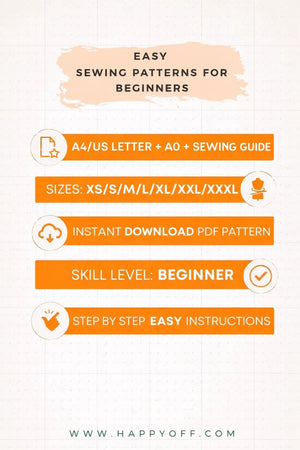
Besides a sewing machine and materials, you will need a home printer and letter or A4 paper to print your pattern pages. If you are using the A0 copy shop file, you will need to have that file printed locally or order it from an online source. If you are piecing your pattern pages together, you will need tape or a glue stick.
Shipping & Refunds
1 - How Long Does it Take to Receive my Pattern?
Our digital sewing patterns are available for instant download once your payment is processed, so you can start sewing right away!
2 - Do you Offer Refunds?
Unfortunately, we do not offer refunds on digital sewing patterns due to their nature. However, if you encounter any issues with your pattern, please contact us and we'll do our best to help you.
WHY CHOOSE OUR PATTERNS
INSTANT DELIVERY
Digital download immediately after purchase.
COMMUNITY TESTED
Patterns tested & loved by our sewing community.
EMAIL SUPPORT
Get help from our sewing experts.
MULTI-SEASONAL
Designs that adapt for any season.
Technical Blueprint Preview
See exactly what you're buying: precision-drafted patterns, layered PDF files, and detailed instruction manuals.

Precision Pattern Lines
Zoomed view of technical drafting lines showing exact measurements and construction details.

Multi-Layer PDF Interface
Interactive PDF with toggleable layers for different sizes and pattern pieces.

Detailed Instruction Manual
Step-by-step assembly guide with illustrations and professional sewing techniques.